Cross-cultural faux pas are going to happen if you interact with people in or from other cultural settings. Beth and I are no strangers to this phenomenon. It has been said that the difference between long-term and short-term missionaries is that the longer you stay in your host country, the more linguistic and cultural mistakes you will make and from which you will need to recover.
For example, for many years we have believed that Ukrainians are the most hospitable people in the world (that part is true) and they love to stay up late with guests forgetting about the time even when they must be up early the next day (that part is not true… mostly). Our friends would rarely let us go home before eleven p.m. “No don’t go!” “C’mon, have some more tea!” “Oh, but we haven’t even had dessert!” “I was just about to roast some more sunflower seeds!” In the face of such encouragement, we were incapable of picking up cultural clues as to when we should break away and just leave already.
Then one day, I was talking to an American friend who had unexpected guests shortly before his expected guests were due to arrive. So, he called a trusted Ukrainian friend and asked what he should do. The friend said, “When you get off the phone with me, tell your kids to go get into their pajamas and get ready for bed.” “But they’ll think it is weird and complain it’s too early,” the ex-pat replied. “Just do it!” said the Ukrainian. My friend took the advice. Within a few minutes, the guests left on their own volition and the kids re-dressed for the next round of guests.
Listening to this story, I was horrified!!! I thought of all the times we over-stayed our welcome naively believing people were interested in our company and conversation. I remembered some people doing the same thing our American friend had done, but to no avail. We simply did not know and for almost twenty years we had bored our hosts by staying far too late. We believed their words and did not understanding their actions.
Every cross-cultural worker has a list of mistakes they have made. It is not a question of “if”, but rather of “when” it will happen and how often. This happens even though we are trained cultural observers. Politicians can make the same mistakes we make. Real estate lawyer turned peace envoy to Russia, Steve Witkoff, has talked about becoming friends with V. Putin. Moreover, he believes that Putin and Trump are friends, at least until recently. Nothing could be further from the truth.
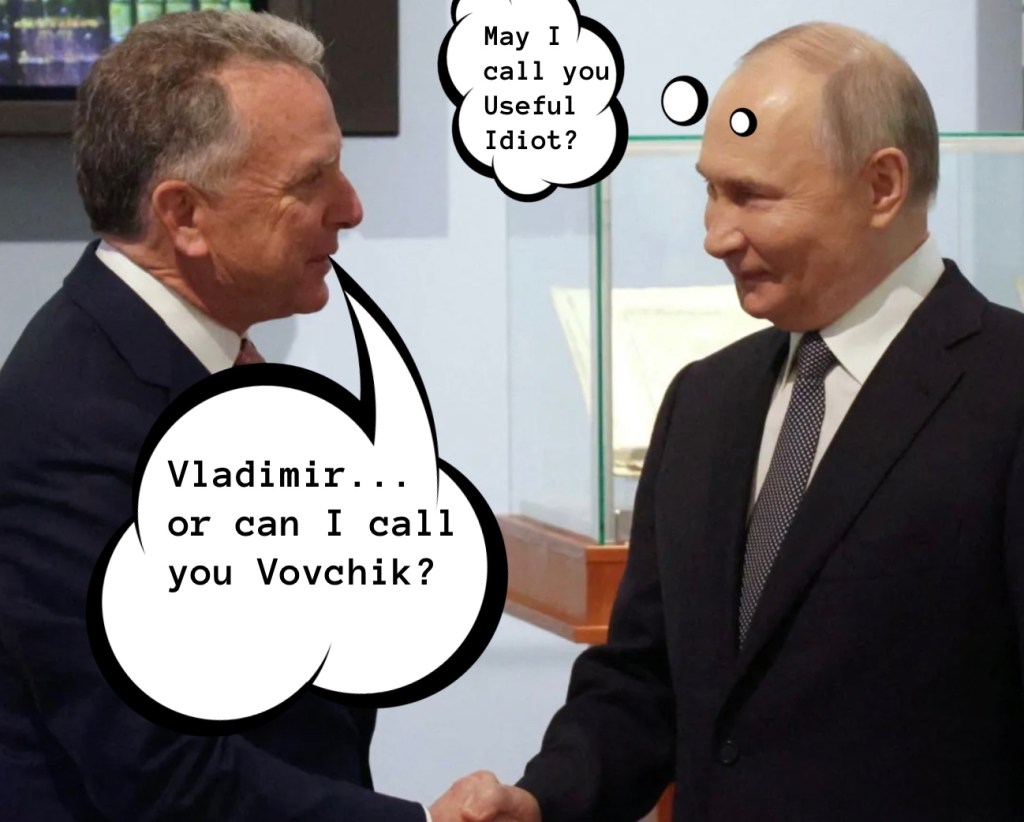
Friends and Acquaintances: A cultural difference that makes all the difference.
For the sake of this article, let us lay aside our belief that Putin is a master manipulator who uses people for his own diabolical purposes. In Russia, the concept of Дружба (friendship) entails a closeness that cannot be achieved by phone calls and state visits. A друг (friend) in Russia is someone who you have known through thick and thin (like David and Jonathan, or Charlie Boorman and Ewan McGregor). It is a person who has your back and you have his… someone you will defend to the gates of Hades and back, knowing he would do the same for you. Someone you can go to the banya (Russian sauna) and who will help you stagger home after getting thoroughly squiffed on vodka. This term, friend, is not used lightly. The discussion of Putin and Trump being friends has even been a subject of comedy in Russia.
Americans are friends with everybody. If we buy meat from the same butcher twice, we’ll say, “I have a friend who works at the butcher store.” Our child comes home from school and we ask, “Did you make any new friends today?” Anybody an American meets is his friend. How often do we introduce someone as our acquaintance?
Eastern Europeans see a great chasm between who is a friend and who is an acquaintance. The distinction is very real to them. Most Russians will have just one or two friends, even though they may have many acquaintances. They may even refer to you as a friend while in your presence to avoid offending you, but when you are not around, someone may ask, “Hey, are you and Joe friends?” Most likely, the answer will be, “Well, we are acquaintances really” or “We are well acquainted” or simply, “I know him.” But to say, “Ми друзі” (we are friends), is an honor given only to those very few with whom we are the closest.
Steve Witkoff, a Trump ally, believes Putin thinks of Trump as a friend. John Bolton, a Trump critic, believes Trump sees himself as being friends with Putin. Obviously, whatever this acquaintance may have been or may not have not been, it seems to have soured as Russia’s continued terror against Ukrainian civilians, which is something I have seen up close and incredibly loud, continues to increase in scope and intensity and makes a mockery of the U.S. president’s attempts to bring about peace.
In conclusion, let us be content with the understanding that the leader of the free world is not a friend, but is only acquainted with the reigning terrorist of the dystopian world. Thankfully, they have never been friends and they never will be.
UPDATE: As our president continues to wake up to the realization that Putin is not his friend, we have finally seen the first sanctions levied on Russia since T47 took office. As of yet, Russia is the only nation that has not had American tariffs levied on them. As DJT levies these sanctions, Ukraine is more than glad to reinforce them with their long range drones.
Eric Yodis has served through WorldVenture in Ukraine since 1995. After nineteen years in eastern Ukraine with his wife, Beth, they fled the war of Russian aggression in June 2014. Since 2015, they have lived in the Kyiv Oblast, but have once again been forced to evacuate due to the continuing war of Russian aggression against the peace loving people of Ukraine. Currently they split their time between the U.S. and Ukraine.

